India’s Urea Security: HURL Explores New Pathways Beyond Natural Gas
Oct 12th, 2026 7:16 pm | By ThenewsmanofIndia.com | Category: SPECIAL NEWS COVERAGE
THE NEWSMAN OF INDIA.COM|Author, Dr. Siba Prasad Mohanty|India’s Urea Security: HURL Explores New Pathways Beyond Natural Gas
Green ammonia, carbon utilisation and indigenous coal gasification could help broaden India’s fertiliser manufacturing base and strengthen long-term raw material security.
India’s progress towards fertiliser self-reliance has reached an important turning point. After expanding domestic urea manufacturing capacity over the past decade, the country now faces a more complex challenge: ensuring that the raw materials and energy required to produce fertilisers are as secure as the finished product itself.
This shift in priorities is becoming increasingly significant for a country whose agricultural productivity and food security depend heavily on the timely availability of affordable fertilisers. While domestic urea production has grown substantially, dependence on imported natural gas and international fertiliser markets continues to expose the sector to external disruptions and price fluctuations.
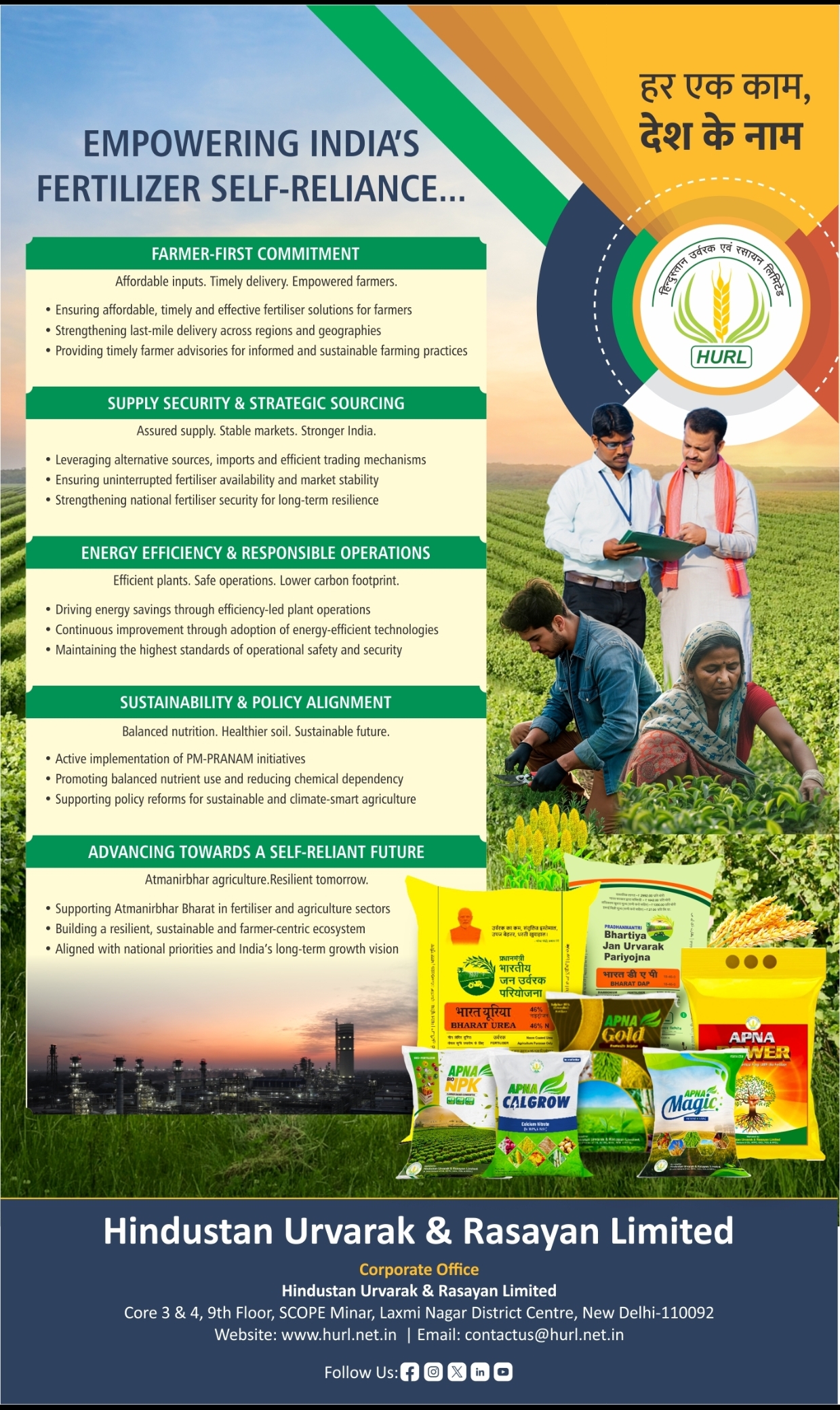
Hindustan Urvarak & Rasayan Limited (HURL) is exploring two alternative production pathways that could contribute to addressing this challenge. At its Barauni unit in Bihar, the company is pursuing the concept of green urea using green ammonia and captured carbon dioxide. At its Sindri unit in Jharkhand, it is exploring the conversion of indigenous coal into feedstock for urea manufacturing.
Together, these initiatives represent an emerging approach to fertiliser security—one that seeks to expand domestic production while diversifying the resources from which it is produced.
The Missing Link in India’s Fertiliser Self-Reliance
India’s urea production has increased from approximately 22.5 million tonnes in 2014–15 to around 30.6 million tonnes in 2024–25. The commissioning and revival of six urea plants added 7.62 million tonnes per annum to the country’s manufacturing capacity, marking a significant step towards reducing import dependence.
Yet, the gap between domestic production and consumption remains substantial. In 2025–26, urea demand was approximately 40 million tonnes, compared with domestic production of around 30 million tonnes. Imports continued to bridge the shortfall.
The challenge is not confined to the quantity of urea produced. Natural gas, the principal feedstock for conventional ammonia-based urea manufacturing, remains a major strategic vulnerability. India’s urea plants consume approximately 55 million standard cubic metres of natural gas per day, with imported liquefied natural gas accounting for a substantial share of the requirement.
Consequently, international energy prices, geopolitical tensions and disruptions to shipping routes can directly affect fertiliser production costs and the financial burden of keeping urea affordable for farmers.
The experience following the Russia–Ukraine conflict in 2022 demonstrated how sharply global gas prices can rise during a geopolitical crisis. More recent disruption risks associated with tensions involving Iran and the Strait of Hormuz have again highlighted the exposure of energy-dependent industries to developments beyond India’s borders.
For the fertiliser sector, the lesson is clear: greater domestic manufacturing capacity must be accompanied by a more diversified and resilient raw material supply chain.
Policy Support Opens New Investment Routes
The government has pursued capacity expansion through investment policies while also examining alternatives to conventional gas-based production.
The New Investment Policy of 2012 facilitated the establishment of six new or revived urea units, including HURL’s plants at Gorakhpur, Sindri and Barauni. In July 2026, the government approved the National Investment Policy for Urea–2026, intended to encourage fresh investment in gas-based urea manufacturing and strengthen domestic availability.
Alongside this conventional route, green ammonia and coal gasification are emerging as complementary options.
The Department of Fertilisers has invited expressions of interest for green urea projects involving green ammonia and captured carbon dioxide. Separately, the Ministry of Coal is promoting coal and lignite gasification for downstream applications, including urea, with a supporting scheme of ₹37,500 crore. Three new urea projects based on coal gasification have also been approved under the earlier initiative.
The development of a green ammonia market is another important step. Under the Strategic Interventions for Green Hydrogen Transition (SIGHT) programme, competitive bidding has produced green ammonia prices in the range of ₹49.75 to ₹64.74 per kilogram. These outcomes provide an initial indication of the commercial possibilities of green ammonia, although its wider adoption will depend on project economics, technology and the availability of reliable renewable power.
This policy environment creates an opportunity to explore multiple feedstock options rather than relying exclusively on a single production model.
Barauni: Connecting Renewable Energy with Fertiliser Production
HURL’s proposed green urea initiative at Barauni seeks to connect the fertiliser industry with the emerging green hydrogen ecosystem.
The project concept draws on the proximity of HURL’s Barauni fertiliser complex to NTPC’s Barauni power facility. Following the Department of Fertilisers’ expression of interest dated 22 June 2026 for domestic green urea production, HURL developed a proposal for integrating green ammonia with carbon dioxide captured from NTPC’s facility.
A memorandum of understanding between HURL and NTPC provides a framework for exploring this collaboration.
The proposed process would use renewable electricity to produce green hydrogen, which can then be used to manufacture green ammonia. Captured carbon dioxide would serve as the carbon-bearing feedstock required for urea synthesis. The resulting integration could bring together renewable energy, industrial carbon utilisation and fertiliser manufacturing within a coordinated production chain.
The concept is significant because it treats carbon dioxide not merely as an emission requiring management, but also as a potential industrial resource. Its utilisation in urea production could create a productive link between the power and fertiliser sectors.
However, the overall environmental benefit would depend on factors including the source of electricity, the efficiency of hydrogen production, carbon capture performance and the lifecycle emissions of the process.
For HURL, Barauni offers an opportunity to examine how established fertiliser infrastructure can be integrated with emerging low-carbon technologies.
Sindri: Exploring the Potential of Indigenous Coal
At Sindri, HURL is examining a different route to feedstock security through coal gasification.
The company has signed an MoU with Coal India Limited (CIL) to jointly explore a coal-to-urea project. The collaboration brings together HURL’s experience in fertiliser manufacturing and CIL’s capabilities in the coal sector.
Under the proposed pathway, indigenous coal would be converted through gasification into synthesis gas. This gas would then undergo processing to produce the hydrogen-rich feedstock required for ammonia manufacture, which would subsequently be used to produce urea.
The strategic rationale extends beyond substituting one fuel for another. Coal gasification could provide an additional domestic source of feedstock for a product that is essential to Indian agriculture, thereby reducing exclusive dependence on imported gas.
At the same time, the commercial and environmental viability of such a project would require careful assessment. Capital costs, gasification efficiency, coal quality, water requirements, carbon emissions and the availability of suitable carbon-management technologies would all influence its long-term performance.
The Sindri proposal therefore represents an opportunity to assess the role of indigenous resources in a diversified fertiliser manufacturing system.
HURL’s Next Phase of Expansion
HURL’s existing plants at Gorakhpur, Sindri and Barauni together have an annual urea capacity of approximately 3.8 million tonnes.
The company is examining additional strategic options at Barauni and Sindri, each envisaged at approximately 1.27 million tonnes per annum. It is also envisaging a gas-based plant at Gorakhpur.
If the proposed green urea and coal-to-urea projects are successfully developed and commissioned, they could add approximately 2.54 million tonnes of annual capacity through alternative feedstock pathways. This would take HURL’s potential total annual capacity to around 6.34 million tonnes, excluding any additional capacity that may arise from the proposed Gorakhpur expansion.
With the planned gas-based expansion also realised, HURL’s overall annual capacity could reach 7.62 million tonnes, positioning it among the country’s largest urea manufacturers.
These figures represent potential future capacity, rather than operational output. Their realisation will depend on investment decisions, project approvals, technology selection, financing and successful commissioning.
Nevertheless, the proposed expansion illustrates how HURL is looking beyond incremental capacity additions towards a broader transformation of its production architecture.
Three Dimensions of Self-Reliance
India’s fertiliser strategy can increasingly be understood through three interconnected objectives.
The first is product self-reliance: producing more urea within the country and reducing the gap between domestic demand and supply.
The second is energy security: ensuring that manufacturing operations have access to reliable and competitively priced energy, even when international markets become volatile.
The third is raw material self-reliance: diversifying the sources of essential feedstocks and making greater use of resources available within India.
Conventional gas-based plants will continue to play an important role in meeting fertiliser demand. Green ammonia and coal gasification are not immediate replacements for the existing production base. Instead, they offer alternative pathways whose respective roles will depend on cost, technology readiness, resource availability and environmental performance.
A diversified portfolio could provide greater flexibility in responding to changing energy markets and supply disruptions. It could also create opportunities for industrial collaboration between fertiliser manufacturers, power producers, coal companies and renewable energy developers.
For policymakers, the task will be to balance affordability for farmers with the long-term economic and environmental sustainability of fertiliser production.
From Domestic Production to Strategic Resilience
The next stage of India’s fertiliser journey will require more than increasing the number or size of urea plants. It will involve strengthening the entire chain—from energy and raw material procurement to ammonia synthesis, carbon utilisation and final fertiliser production.
HURL’s proposed initiatives at Barauni and Sindri reflect this wider ambition. One explores the integration of green hydrogen, green ammonia and captured carbon dioxide; the other examines the potential of indigenous coal gasification. Both seek to expand the range of resources that could support domestic urea manufacturing.
Their success will ultimately be measured not only by additional tonnes of production, but also by their ability to deliver dependable supply, viable economics and improved resilience against external shocks.
India has made substantial progress in expanding its urea manufacturing capacity. The emerging opportunity is to make that capacity more secure at its foundation.
The broader objective is therefore to move from making fertiliser in India to producing it increasingly through diversified and strategically secure Indian resource pathways. That transition could become an important component of the country’s long-term agricultural security and industrial self-reliance.
The author, Dr Siba Prasad Mohanty, is Managing Director of Hindustan Urvarak & Rasayan Limited (HURL).