Madhya Pradesh Leads National Swachh Survekshan Awards with Nine Honours
Nov 11th, 2026 11:10 pm | By ThenewsmanofIndia.com | Category: TOP STORIES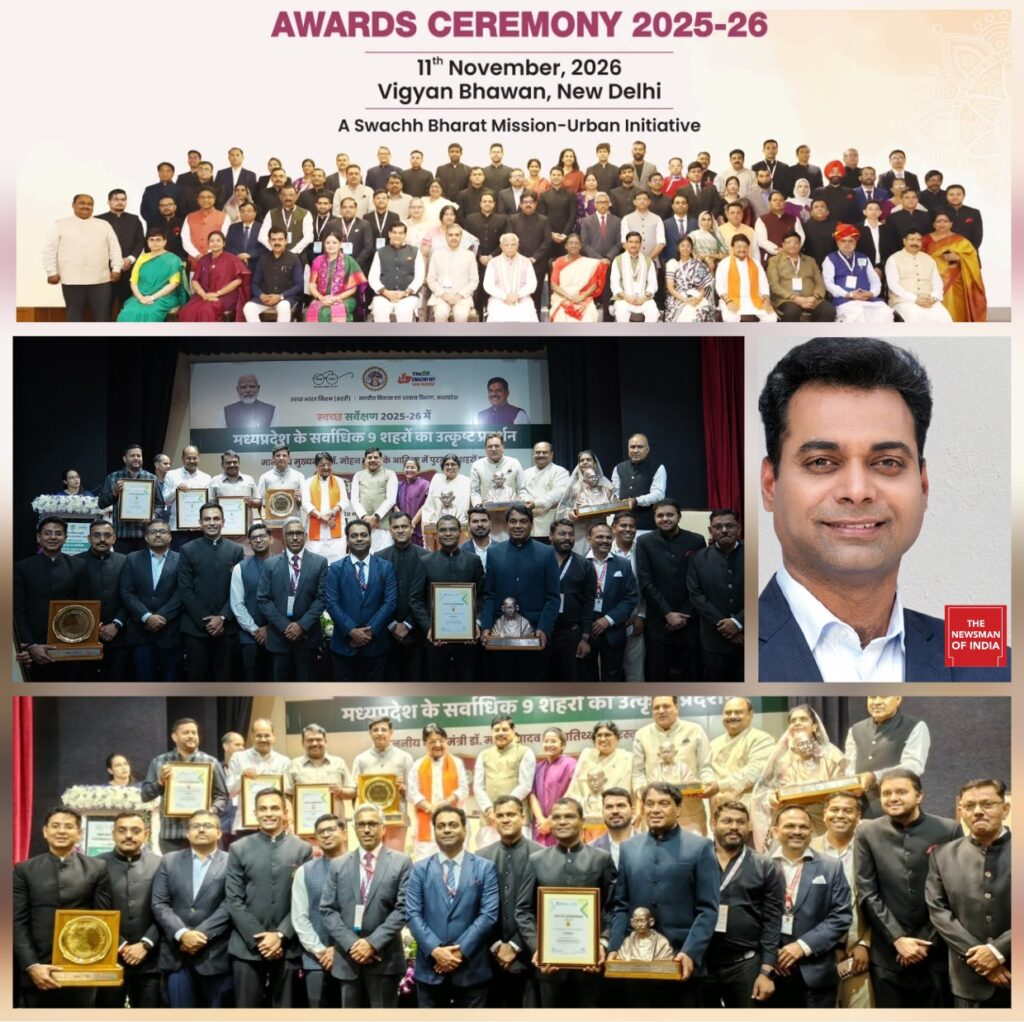
By THE NEWSMAN OF INDIA.COM|Urban Development Department under the administrative leadership of Sanjay Dubey,IAS and Sanket S. Bhondve, IAS, earns national recognition for coordinated efforts in urban sanitation, scientific waste management and municipal governance
Madhya Pradesh has achieved significant national recognition in urban cleanliness, with nine of its cities receiving honours under the Swachh Survekshan 2025–26. The state has secured the highest number of national awards among all states, reflecting the sustained efforts of its Urban Development Department, municipal administrations, sanitation workers and citizens towards improving urban sanitation and civic infrastructure.
At the administrative level, the contribution of Sanket S. Bhondve, a 2007-batch Indian Administrative Service officer of the Madhya Pradesh cadre and Commissioner, Urban Development Department, Government of Madhya Pradesh, assumes particular significance. The department’s coordinated approach to municipal performance, implementation monitoring and capacity building has been an important part of the state’s urban development efforts.
The awards were presented by President Droupadi Murmu at Vigyan Bhawan, New Delhi, on November 11, 2026, in the presence of Union Housing and Urban Affairs Minister Manohar Lal and Minister of State Tokhan Sahu.
Nine cities bring national recognition to the state
The nine award-winning cities are Indore, Gwalior, Jabalpur, Rewa, Ujjain, Sagar, Dewas, Budhni and Depalpur. Their achievements span different population categories and specialised cleanliness initiatives, demonstrating that effective urban management is possible across metropolitan centres, medium-sized cities and smaller municipalities.
Jabalpur secured the second position in the category of cities with a population exceeding one million, while Ujjain secured first position in the three-to-ten lakh population category. Dewas achieved first position in the 50,000-to-three-lakh population category, with Sagar securing third position in the same category.
Budhni earned third position among cities with populations below 20,000. Rewa received first position in the Swachh River Front Town category, while Gwalior was recognised with the State First Swachh City Award.
Indore and Depalpur secured second position nationally in the Swachh Shehar Jodi category, highlighting the effectiveness of inter-city cooperation and knowledge-sharing in improving sanitation standards.
Sanket S. Bhondve’s administrative stewardship
The recognition places a spotlight on the role of the Urban Development Department in coordinating sanitation initiatives across the state’s urban local bodies.
As Commissioner, Urban Development Department, Sanket S. Bhondve has an important administrative responsibility in translating the state’s urban development priorities into measurable outcomes. This involves coordination with municipal corporations, municipal councils and other urban local bodies, strengthening institutional capabilities, reviewing implementation and encouraging the adoption of technology-driven solutions.
The department’s approach to cleanliness requires sustained engagement at multiple levels, from policy formulation and administrative monitoring to field-level execution. Municipal commissioners, chief municipal officers, sanitation supervisors and frontline workers collectively contribute to the delivery of these services.
The nine national awards provide an important indication of the results that coordinated institutional efforts and performance-oriented municipal administration can achieve.
Swachh Shehar Jodi: A model of collaborative governance
One of the notable features of this year’s recognition is the Swachh Shehar Jodi initiative, under which Indore served as mentor to Depalpur.
The partnership demonstrates how an established urban local body can share technical expertise, operational practices and institutional experience with a smaller municipality.
With guidance from Indore, Depalpur strengthened door-to-door waste collection, introduced four-category waste segregation and undertook scientific treatment of legacy waste. The town achieved zero legacy waste during the assessment period, with approximately 1,250 metric tonnes of old waste scientifically treated and around 2.2 acres of land reclaimed.
This model of inter-city cooperation highlights the importance of knowledge transfer, institutional mentoring and continuous performance monitoring in improving urban sanitation.
Scientific waste management and citizen participation
The Swachh Survekshan 2025–26 assessment covered more than 4,751 urban local bodies and evaluated performance against 43 indicators across 10 key areas.
These included door-to-door waste collection, segregation at source, transportation and processing of municipal waste, public-space cleanliness, sanitation infrastructure, used-water management, citizen participation and the welfare of sanitation workers.
Madhya Pradesh’s recognised cities have demonstrated different approaches to these challenges.
Jabalpur’s waste-to-energy infrastructure, Ujjain’s waste segregation across its wards, Dewas’s legacy-waste management and water-recycling initiatives, and Sagar’s efforts to connect cultural activities with public awareness illustrate the diverse approaches adopted by urban local bodies.
The contribution of Safai Mitras remains central to these achievements. Their daily work in waste collection, street cleaning, sanitation maintenance and public hygiene forms the foundation of every successful cleanliness initiative.
Equally important is citizen participation, which ensures that cleanliness becomes a shared civic responsibility rather than merely a municipal function.
Beyond rankings: Building sustainable urban institutions
The latest Swachh Survekshan recognition is an important milestone, but the larger objective of urban development extends beyond awards and rankings.
Scientific processing of waste, reduction of landfill dependency, effective sewage treatment, recycling, protection of water bodies, improved public sanitation and environmentally responsible urban planning remain essential priorities.
For the Urban Development Department, the next phase involves sustaining the achievements of award-winning cities while extending successful practices to other urban local bodies across the state.
Technology-enabled monitoring, professional capacity building, transparent performance assessment and stronger citizen engagement can further improve the quality of municipal services.
A collective achievement and a continuing commitment
Madhya Pradesh’s nine national awards represent the combined efforts of administrative leadership, municipal institutions, elected representatives, sanitation workers and citizens.
Under the administrative stewardship of Sanket S. Bhondve, the Urban Development Department has an important role in consolidating these achievements and strengthening the state’s urban governance framework.
The recognition also reinforces an important principle of public administration: lasting urban transformation is achieved through institutional coordination, consistent implementation, innovation and people’s participation.
With nine cities receiving national recognition, Madhya Pradesh has demonstrated the value of a coordinated approach to cleanliness and urban management. The continuing challenge is to ensure that these achievements translate into cleaner neighbourhoods, better civic services and healthier, more sustainable communities across the state.