Voruganti Srinivas Calls for Next-Generation Governance at 51st EGPA Conference in Rome, Italy
Aug 25th, 2026 5:54 pm | By ThenewsmanofIndia.com | Category: SPECIAL NEWS COVERAGE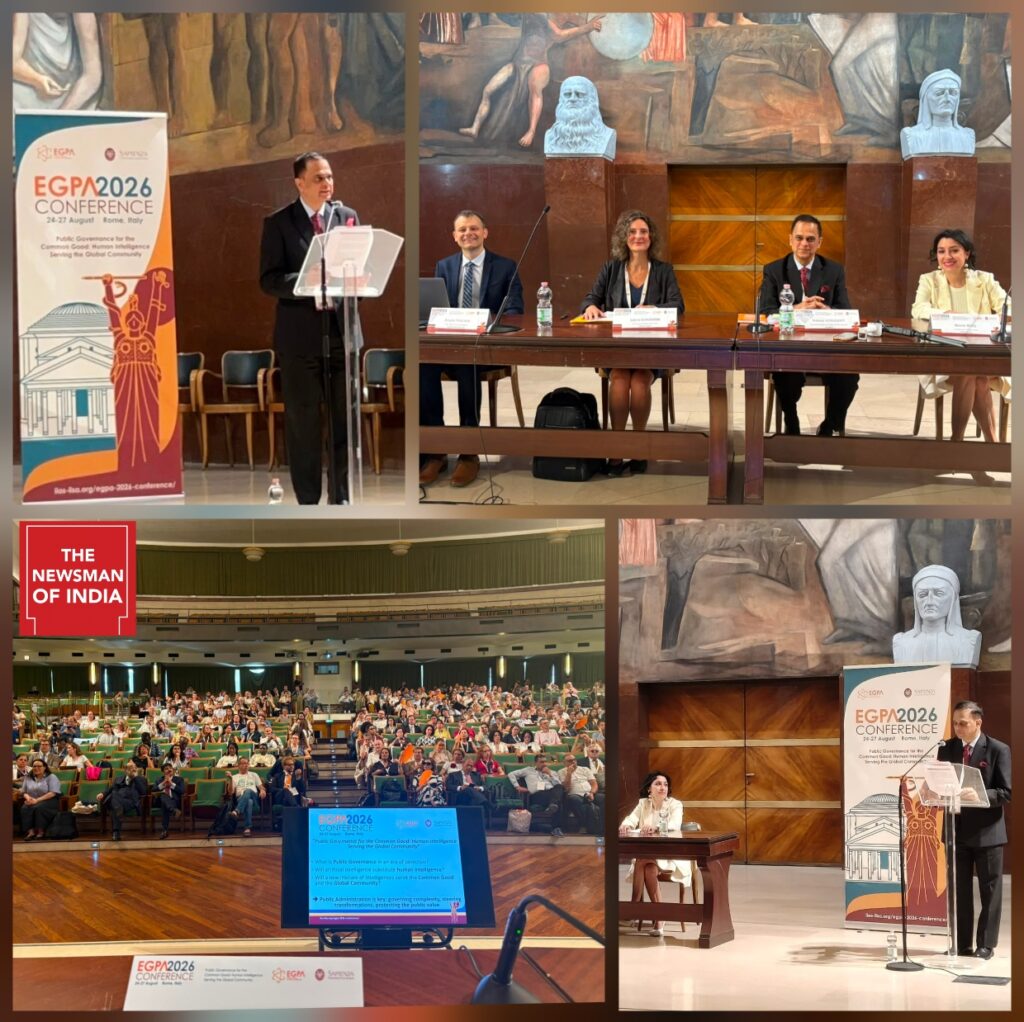
By Abul Hasan|THE NEWSMAN OF INDIA.COM|Public Governance for the Common Good: Human Intelligence Serving the Global Community
The 51st Conference of the European Group for Public Administration (EGPA), being held at Sapienza University in Rome, has brought together an impressive global community of scholars, administrators, researchers and practitioners to deliberate on one of the defining questions of our time: how public governance can serve the common good in an increasingly complex and technology-driven world.
Delivering the IIAS Presidential Address on 25 August 2026, Voruganti Srinivas, IAS, President of the International Institute of Administrative Sciences (IIAS) and Chief Secretary, Government of Rajasthan, placed human intelligence, institutional capability and citizen-centric governance at the centre of the global public administration discourse.
The conference, themed “Public Governance for the Common Good – Human Intelligence Serving the Global Community,” has attracted more than 900 submissions from over 70 countries. Srinivas described the gathering as a landmark moment for EGPA, reflecting the growing international engagement of the public administration community. The four-day programme features a PhD Symposium, Permanent Study Groups, specialised panels, Transatlantic and Mediterranean Dialogues, a Euro-Asia Panel and discussions on the future direction of public administration.
IIAS: Building Bridges Across Administrative Sciences
Srinivas highlighted the historic role of the IIAS in promoting comparative public administration, scientific methods, administrative research and international cooperation. With its regional entities and associations spanning Europe, Asia and Latin America, the IIAS has developed a global network connecting governments, academia, civil servants and researchers.
As the IIAS approaches its centenary in 2030, Srinivas articulated a vision of an institution that is digitally agile, rich in publications and resources, and capable of serving as a global knowledge institution. He emphasised that the future of administrative sciences must be founded on “collaboration without borders, knowledge without boundaries and governance without exclusion.”
India’s Next Generation Governance Reforms
Drawing from India’s governance experience, Srinivas connected the conference theme with the country’s reform agenda and the vision of Viksit Bharat@2047. He highlighted the principles of maximum governance and minimum government, last-mile service delivery, digital empowerment, grievance redressal, capacity building and whole-of-government coordination.
Technology, he noted, is transforming the relationship between citizens and institutions. Platforms such as UMANG, digital public infrastructure, Aadhaar-enabled services and emerging artificial intelligence applications are creating new possibilities for efficient and accessible governance.
He also underlined the importance of social equity, justice, transparency and accountability, with citizen empowerment remaining at the heart of India’s development approach.
Rajasthan as a Governance Laboratory
As Chief Secretary of Rajasthan, Srinivas presented several state-level initiatives as examples of next-generation administrative reforms. Rajasthan Jan Sampark has strengthened technology-enabled grievance redressal, while Raj Kaj analytics has supported performance assessment, records management and administrative efficiency.
Mission Rajeevika was highlighted for its potential to strengthen women’s economic empowerment through credit, marketing and skill linkages. The Raj Unnati initiative, meanwhile, has provided structured monitoring of major infrastructure projects and priority-sector schemes, helping accelerate critical investments across sectors.
These initiatives, Srinivas suggested, demonstrate how technology can complement administrative leadership while keeping citizens at the centre of governance.
EGPA’s Roadmap for the Future
Looking ahead, Srinivas called for EGPA to deepen its engagement with digital transformation, sustainability and citizen-centric governance while expanding opportunities for younger scholars and practitioners. He advocated stronger international partnerships, greater interdisciplinary research and closer engagement between academics and policymakers.
His address also emphasised inclusivity, transparency and institutional autonomy, while envisioning stronger collaboration between EGPA and IIAS without compromising EGPA’s distinctive European identity.
The Rome conference therefore represents more than an academic gathering. It is a meeting point for ideas on how governments can respond to technological change, global interdependence and rising citizen expectations.
At its heart lies a simple but powerful proposition: technology may transform governance, but human intelligence, institutional values and public purpose must continue to guide it. As the global administrative community looks towards the next generation of reforms, the common good remains the ultimate measure of effective governance.