Gujarat’s Water Conservation Model Delivers Results: Ahmedabad & Gandhinagar Register Significant Groundwater Recovery
Aug 4th, 2026 5:59 am | By ThenewsmanofIndia.com | Category: LATEST NEWS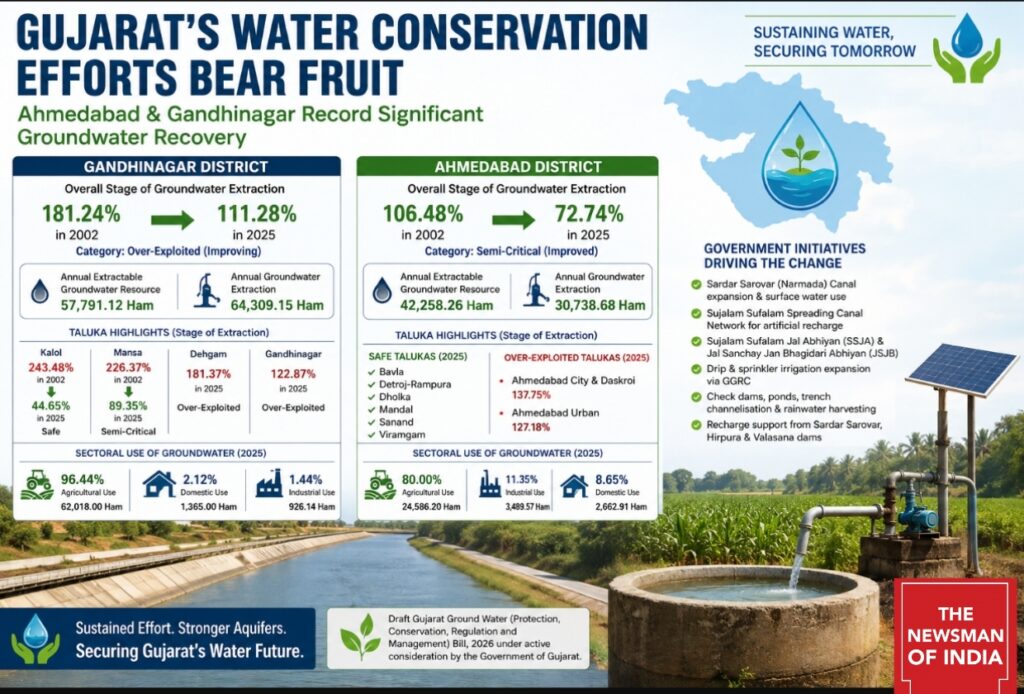
By THE NEWSMAN OF INDIA.COM|
The Government of Gujarat’s sustained investments in water conservation, surface water distribution and scientific groundwater management have yielded encouraging results, with Ahmedabad and Gandhinagar districts recording significant improvements in groundwater status over the past two decades. The latest Groundwater Resource Assessment (2025) highlights measurable recovery in several talukas, reflecting the impact of integrated policy interventions, community participation and efficient water-use practices. While localized groundwater stress persists in some urban centres, the overall trend points towards a positive transformation.
Gandhinagar Records Strong Recovery
Gandhinagar district has reduced its overall stage of groundwater extraction from 181.24% in 2002 to 111.28% in 2025. Although the district remains in the “Over-Exploited” category, the reduction represents a significant improvement in groundwater sustainability.
The assessment records remarkable recoveries in individual talukas. Kalol has moved from an extraction level of 243.48% in 2002 to just 44.65% in 2025, graduating to the Safe category. Mansa has similarly improved from 226.37% to 89.35%, shifting to the Semi-Critical category.
Dehgam (181.37%) and Gandhinagar taluka (122.87%) continue to remain Over-Exploited, indicating that focused conservation efforts are still required in these areas.
The district receives an annual groundwater recharge of 63,300.32 Ham (633.00 MCM). After natural discharge of 5,509.19 Ham, the annual extractable groundwater resource is estimated at 57,791.12 Ham, against an annual groundwater extraction of 64,309.15 Ham.
Agriculture continues to account for the overwhelming share of groundwater use at 62,018.00 Ham (96.44%), while domestic consumption stands at 1,365.00 Ham (2.12%) and industrial use at 926.14 Ham (1.44%).
Ahmedabad Achieves Category Upgrade
Ahmedabad district has made an equally noteworthy transition. Its overall groundwater extraction level has declined from 106.48% in 2002 to 72.74% in 2025, enabling the district to move from the Over-Exploited category to the Semi-Critical category.
The assessment shows that six of the eight inland extractable talukas—Bavla, Detroj-Rampura, Dholka, Mandal, Sanand and Viramgam—are now categorised as Safe.
Groundwater pressure, however, remains concentrated in urban growth centres. Ahmedabad City & Daskroi records an extraction stage of 137.75%, while Ahmedabad Urban stands at 127.18%, both continuing in the Over-Exploited category.
The district’s annual extractable groundwater resource is estimated at 42,258.26 Ham from a total annual recharge of 45,772.96 Ham. Annual groundwater extraction stands at 30,738.68 Ham.
Agriculture accounts for 24,586.20 Ham (80% of total groundwater draft), followed by industrial use at 3,489.57 Ham (11.35%) and domestic consumption at 2,662.91 Ham (8.65%).
Government’s Multi-Pronged Strategy Delivers Results
The assessment attributes the improvement to a comprehensive and sustained approach adopted by the Government of Gujarat towards water resource management.
Expansion of the Sardar Sarovar (Narmada) Canal command has significantly reduced dependence on deep borewell irrigation by providing reliable surface water to farmers. The Sujalam Sufalam Spreading Canal Network has strengthened artificial groundwater recharge by channelising Narmada waters into drought-prone aquifers across North Gujarat.
Large-scale community initiatives such as the Sujalam Sufalam Jal Abhiyan (SSJA) and the Jal Sanchay Jan Bhagidari Abhiyan (JSJB) have contributed through pond deepening, desilting of check dams, trench channelisation, borewell revival and rainwater harvesting.
The Gujarat Green Revolution Company (GGRC) has expanded drip and sprinkler irrigation, helping reduce groundwater consumption while improving irrigation efficiency. Recharge support from the Sardar Sarovar, Hirpura and Valasana dams has further strengthened groundwater reserves across the region.
The report also notes that the draft Gujarat Ground Water (Protection, Conservation, Regulation and Management) Bill, 2026 is under active consideration by the Government of Gujarat, reflecting its continued focus on sustainable groundwater governance.
A Model of Sustainable Water Management
The findings underscore the effectiveness of Gujarat’s long-term and coordinated approach to water conservation. The remarkable recovery witnessed in Kalol, Mansa and six rural talukas of Ahmedabad demonstrates how sustained public investment, scientific planning and active community participation can reverse groundwater depletion.
While challenges remain in rapidly urbanising areas where groundwater demand continues to outpace recharge, the overall assessment presents an encouraging picture of steady progress. The achievements recorded in Ahmedabad and Gandhinagar reinforce the importance of continued investment in surface water infrastructure, artificial recharge, micro-irrigation and community-led conservation as Gujarat advances towards long-term water security.
A suitable disclaimer for this article is:
Disclaimer: The facts, figures, groundwater assessment data and statistical information presented in this article are sourced from the latest official Government of Gujarat Groundwater Resource Assessment (2025) and other government reports available at the time of publication. The analysis has been prepared in good faith for informational purposes and reflects the findings of the official reports. Any subsequent revisions or updates by the concerned government authorities shall prevail.