Women at the Helm: Telangana’s Governance Model Gains Momentum with 13 Women District Collectors
Feb 27th, 2026 11:31 am | By ThenewsmanofIndia.com | Category: LATEST NEWS
By THE NEWSMAN OF INDIA.COM| In a notable administrative initiative reflecting progressive governance and inclusive leadership, the Government of Telangana, under the stewardship of Chief Minister A. Revanth Reddy, has entrusted district administration across the state to a strong cohort of women officers. The appointment of 13 women District Collectors marks a decisive step toward strengthening grassroots governance while advancing women’s empowerment through institutional leadership.
Far from being a symbolic gesture, the move represents a structural administrative decision designed to enhance efficiency, accountability, and responsiveness in public service delivery. By placing experienced women IAS officers at the forefront of district administration, Telangana has reinforced the role of merit-based leadership in shaping governance outcomes.
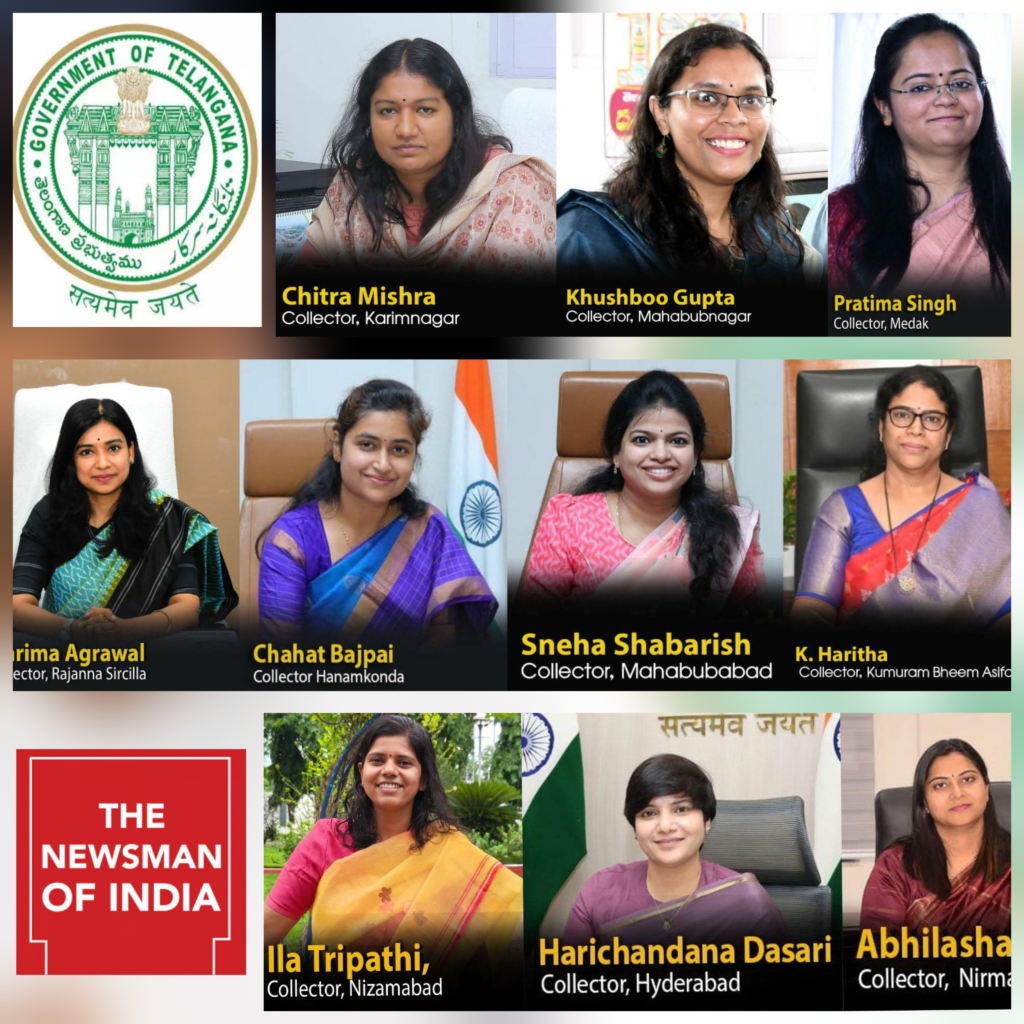
Women Collectors Leading Key Districts
The districts currently led by women Collectors reflect a broad geographical and administrative spread across Telangana:
Nizamabad – Ila Tripathi
Hyderabad – Hari Chandana
Nirmal – Abhilasha Abhinav
Mahabubnagar – Khusboo Gupta
Karimnagar – Chitra Mishra
Mahabubabad – Sneha Shabarish
Medak – Prathima Singh
Rajanna Sircilla – Garima Agrawal
Siddipet – Hymavathi
Warangal – Satya Sharadha
Sangareddy – Pravinya
Hanmakonda – Chahat Bajpai
Kumuram Bheem Asifabad – Haritha
This administrative configuration underscores the government’s confidence in women officers handling complex governance responsibilities in both urban and rural districts.
Strengthening the Backbone of Governance
District Collectors occupy one of the most critical positions in India’s administrative framework. They supervise revenue administration, coordinate law and order mechanisms, oversee disaster management, and ensure effective implementation of welfare and development schemes.
With women officers leading these districts, governance mechanisms have witnessed renewed emphasis on responsiveness and coordination. Administrative observers note improvements in grievance redressal systems, closer monitoring of welfare programs, and enhanced inter-departmental collaboration.
A focused approach toward health services, education delivery, and women-centric initiatives has also gained momentum, reflecting a governance style rooted in community engagement and inclusive administration.
Administrative Efficiency Through Inclusive Leadership
The decision aligns governance with representation while reinforcing the principle that leadership roles are defined by competence and performance. Women Collectors are not merely representatives of gender inclusion; they are key drivers of policy execution at the grassroots level.
Their leadership has contributed to tighter monitoring of development works, improved implementation timelines, and stronger outreach of flagship welfare schemes. From infrastructure expansion to revenue reforms, district administrations under their stewardship have demonstrated administrative agility and citizen-centric functioning.
Beyond Symbolism: A Governance Transformation
Telangana’s approach highlights a broader shift in public administration — moving from representation as symbolism to representation as operational strength. By entrusting major districts to women officers, the state has institutionalized confidence in women-led governance at scale.
This initiative also sends a powerful message across administrative systems nationwide: empowering women within decision-making structures strengthens institutions themselves. When leadership opportunities expand, governance becomes more participatory, accountable, and responsive to societal needs.
A Model for the Future
As Telangana continues to advance its development agenda, the presence of women Collectors across key districts stands as a visible and effective example of inclusive governance in action. The initiative not only enhances administrative performance but also inspires a new generation of women aspiring to leadership roles in public service.
By integrating women’s leadership into the core of district administration, the state has demonstrated that empowerment is most meaningful when it is embedded within governance structures — shaping policy implementation, strengthening institutions, and delivering tangible outcomes at the grassroots level.